Why Did My Franklin County Property Taxes Go Up?
You bought or refinanced in the last couple of years, your monthly mortgage payment crept up a few hundred dollars, and when you finally opened the statement to figure out why, it wasn't the loan. It was the taxes. If you own in Franklin County and you're staring at a bigger property tax bill wondering what happened and whether you're getting hosed, here's the straight answer.
Your home's taxable value went up a lot in the 2023 county reappraisal, but because of a 1976 Ohio law called House Bill 920, your tax bill did not climb anywhere near as much as your value did. Most Franklin County homeowners pay an effective rate right around 1.7 percent of what the home is actually worth, which on a $300,000 house runs a little over $5,000 a year, or roughly $430 a month folded into your payment. Where that number lands comes down almost entirely to one thing, and it isn't the county. It's your school district. Two identical houses at the same price can sit a few hundred dollars a month apart on taxes alone.
Let me walk you through the whole thing, because this is one of those areas where the rules are genuinely on your side and almost nobody explains them.
How much are Franklin County property taxes, really?
Ohio taxes you on 35 percent of your home's market value, not the full value. So a house the county says is worth $300,000 has a taxable, or assessed, value of $105,000. Every levy your community has ever passed gets applied to that $105,000 number, not the $300,000.
Add up all those levies and you get your total millage rate. Here is where the same $300,000 house lands very differently depending on the line on the map:
- City of Columbus: about 115.89 mills
- Reynoldsburg: about 120.89 mills
- Grove City: about 123.84 mills
- Westerville: about 128.82 mills
- Upper Arlington: about 150.04 mills
- Worthington: about 150.37 mills
- Hilliard: about 152.76 mills
- Bexley: about 156.77 mills
Those are the gross rates. What you actually pay, the effective rate, is lower after the reductions I'll explain in a second. But the pattern holds: Columbus itself is often cheaper on taxes than the suburbs wrapped around it, and the communities at the top of that list are there because they've voted in strong, well-funded school districts. You are not paying for the county. You are paying for the schools, and to a lesser degree the libraries, parks, and safety levies your neighbors approved at the ballot box.
That's the real lesson: when two houses are the same price but one has a payment a couple hundred a month higher, the school district is usually the reason. This is exactly why I tell every buyer to run the total, not the monthly. The sticker price is only half the story.
How do I know my real schools and taxes in Westerville or New Albany?
You pull the specific parcel, because honestly there is barely any rhyme or reason to it from the outside. The part of town you are shopping does not automatically set your school district, your taxing city, and your mailing address the same way. Those are three separate things, and around here they do not line up on a clean grid.
Run up North Hamilton Road and you will find houses that feed Columbus City Schools sitting right between neighbors whose mail says Westerville. Head out toward New Albany and you will find New Albany addresses that pay Columbus taxes. A house two doors down can land completely differently than the one you are standing in, and none of it is obvious from a map pin, a listing, or the city name on the mailbox.
That is not a small difference. It can be a couple hundred dollars a month and a completely different school assignment. So I do not guess, and I do not let a client guess either. Before you fall for a house, I pull that exact parcel and hand you the real city, the real school district, and the real tax rate for that specific address. Not the area, not the mailing name, the actual house. Around Columbus, that is the only thing that tells you the truth. Pulling the exact city, school district, and tax rate for a specific parcel takes me about five minutes, and I do it for every client, because assuming any of it is where real money gets lost.
Why did my property taxes go up in the first place?
In 2023, Franklin County did its full reappraisal and residential values jumped hard, on the order of 43 percent countywide. Your 2026 tax bills are still built on those 2023 values. So if your taxes feel like they took a step up over the last two years, that reappraisal is why.
But here's the part that trips everyone up, and it's the whole point of this article.
Does a higher home value mean a proportionally higher tax bill?
No. And this is the piece almost no one gets right.
Ohio's House Bill 920, passed back in 1976, exists for exactly this situation. When your value goes up, HB 920 automatically rolls back the effective rate on your existing voted levies so that each levy keeps collecting roughly the same total dollars it was approved to collect. The levy doesn't get a raise just because home values inflated. You get a credit on your bill, and your effective rate quietly drops.
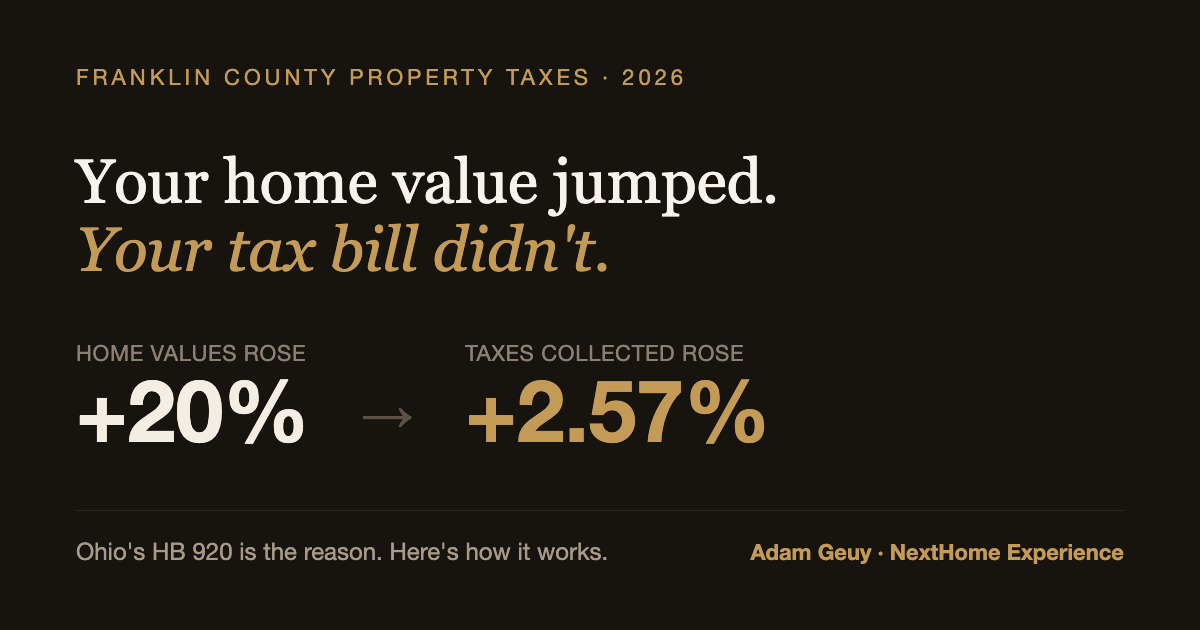
The proof is in the last cycle. After the 2020 update, residential values across the county rose about 20 percent. You'd expect tax collections to rise 20 percent too. They rose 2.57 percent. That gap is HB 920 doing its job.
The practical translation: a school, city, or library only collects meaningfully more money from you when voters pass a brand new levy. Rising home values alone don't hand them a windfall, and they don't hand you a proportional bill. So when a neighbor says "my house is worth 40 percent more so my taxes must be 40 percent higher," they're almost always wrong, and usually relieved when I show them why.
One honest footnote, because I don't do fluff: a handful of districts sit at what's called the 20-mill floor, and those districts can capture more as values rise. If you're in one, your bill can move more than your neighbor's across the county line. That's district-specific, and it's one of the things I check when I pull a parcel.
What's happening with the 2026 reappraisal?
Franklin County ran its triennial update this year. The tentative word is residential values are up around 9 percent on average, a far cry from the 43 percent shock of 2023. Tentative value notices started going out to owners in June.
Two things to hold onto:
First, this 2026 update hits your 2027 tax bill, not your 2026 bill. You have time.
Second, if your new tentative value looks too high, you can request an informal review with the Auditor at no cost before it's finalized. That's the easy, early, free swing, and most people don't take it.
What if I'm buying new construction? The surprise builders don't always mention
This is the one that catches people off guard every single time, and it deserves its own section because so few buyers see it coming.
When you buy in a brand new subdivision, that first tax bill is often tiny, sometimes just a few hundred dollars a year. That is not your real bill. You're being taxed on a vacant lot, because on the county's assessment date the house either wasn't standing yet or wasn't finished. Then the subdivision gets built out, the lots are "improved," and the county reassesses. The full value of the home lands on the tax rolls, and most new-construction buyers end up with a tax bill meaningfully higher than the number the builder quoted them. That's assuming the builder handed them a real number at all, and plenty don't.
I've watched this blindside good people who did everything right. They budgeted off the builder's figure, moved in, and got a very different bill the following year.
So here's how I run it: every one of my new-construction clients gets a full breakdown of what homes in that immediate area are actually paying, before they ever sign a thing. The number they plan around is the real one, not the teaser. Fully informed at every step, that's the whole job. Run the total, not the monthly, and definitely not the builder's first-year, land-only estimate.
Can I actually lower my property taxes?
Yes, and there are three real levers.
Challenge the value. If the county has your home valued higher than it would actually sell for, you file a DTE Form 1 with the Franklin County Board of Revision. The deadline is March 31 of the year after the tax year in question. You carry the burden of proof, so you show up with recent comparable sales, a professional appraisal, or photos of real problems the county can't see from the street. This is where an agent earns their keep, because pulling the comps that prove your case is the whole ballgame.
Homestead Exemption. If you're 65 or older, permanently disabled, or a qualifying surviving spouse, and your household income is $40,000 or less, the homestead exemption shields $29,000 of your home's value from tax. Disabled veterans at a 100 percent rating get $58,000 shielded with no income limit. You apply with a DTE Form 105A by December 31.
Owner-Occupancy Credit. If you live in the home as your primary residence, you get a credit on levies passed in or before November 2013. It's small, but it's automatic if you claim it, and you can only claim it on one property.
And keep the dates straight so you're never late: Franklin County taxes are due in two halves, the first around the end of February and the second no earlier than July 20.
The bottom line on Columbus property taxes
Your value went up. Your bill went up less than you feared, on purpose, because of a law most people have never heard of. What you actually pay is driven by your school district far more than anything else, and if your value looks wrong, you have real, dated, winnable ways to fight it.
Here's the offer, and it's a real one: send me your address and I'll pull your parcel's actual tax history, tell you the effective rate you're really paying, flag whether your value looks appealable, and show you what the 2026 update is likely to do to next year's bill. No cost, just the numbers on your specific house. That's the kind of thing that should be free, and from me it is.
Common questions
How much are property taxes in Franklin County, Ohio?
Ohio taxes you on 35 percent of your home's market value, so a $300,000 house has a taxable value of $105,000. Most Franklin County homeowners pay an effective rate right around 1.7 percent of market value, which runs a little over $5,000 a year on a $300,000 home. Where you land depends mostly on your school district, not the county.
Does a higher home value mean a higher property tax bill in Ohio?
Not proportionally. Ohio's House Bill 920 rolls back the effective rate on your existing voted levies as values rise, so each levy keeps collecting about what voters approved. After the 2020 update, home values rose 20 percent countywide but taxes actually collected rose only 2.57 percent. A district generally only collects meaningfully more when voters pass a brand new levy.
Does a Westerville or New Albany mailing address mean I pay their taxes and get their schools?
Not reliably. Your address, your taxing city, and your school district are three separate boundaries that do not line up on a clean grid. Some homes with a Westerville address sit inside Columbus with Columbus schools and Columbus taxes, and some New Albany addresses pay Columbus taxes. The only way to know for a specific home is to pull that exact parcel.
Can I lower my Franklin County property taxes?
Yes. You can challenge your value by filing a DTE Form 1 with the Board of Revision by March 31 of the year after the tax year, backed by recent comparable sales. You may also qualify for the Homestead Exemption if you are 65 or older, permanently disabled, or a qualifying surviving spouse under the income limit, plus the Owner-Occupancy Credit on your primary residence.