New Construction in Powell, Ohio: Is It Worth It vs Resale?
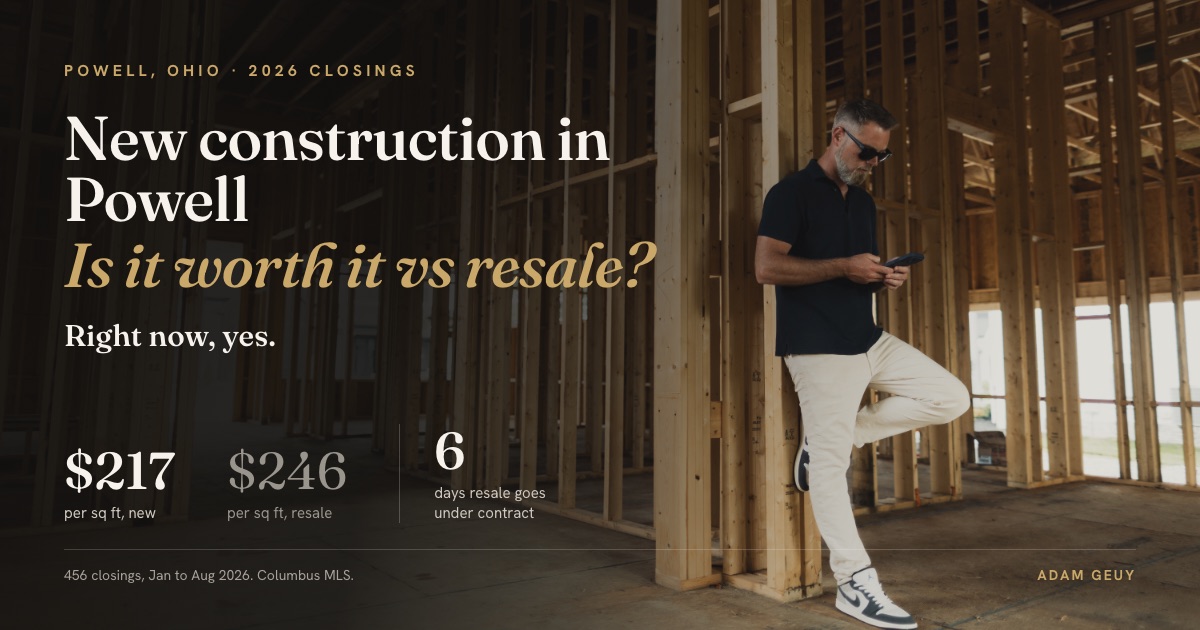
Short answer: right now, yes. Through August of 2026, new construction in Powell closed at a median of $478,585. Resale closed at $549,900. That is $71,315 less for the new house, and it is not a trick of square footage, because new construction also came in cheaper per foot, $217 against $246. Powell is one of a small number of Central Ohio towns where the new home is the cheaper home, and I want to show you why before you assume it is too good to be true.
That runs against everything you have been told about new construction. The standard line is that you pay a premium for new, and in most of this metro you do. In Hilliard the median new construction close sits 61 percent above resale. In Grove City it is 50 percent above. Powell is sitting at negative 13 percent, and it stays negative when you control for size.
Why is new construction cheaper than resale in Powell?
Because you are not in a bidding war, and the resale buyer is.
Here is the number that explains the whole post. In 2026, Powell resale homes went under contract in a median of 6 days.
Six days is not a market. It is a queue. A house lists on Thursday, it is shown thirty times over a weekend, and by Tuesday somebody has beaten four other people to it by paying more than the last one asked. Every resale closing in that median got there by outbidding a real person.
A builder is not standing in that line. Their price is set weeks ahead against a release schedule and a margin, and it does not move upward because three families walked the model on Saturday. There is nobody to outbid. You are buying at the number on the sheet.
Six days is not a market. Six days is a scramble. It means the good resale homes in Powell get multiple offers before most buyers have rearranged a Tuesday to see them, and the winning offer is the one that stops being careful. Builders are not standing in that line. A builder prices to a release schedule and a margin, and that price sits there while you think about it.
So the resale premium in Powell is not really a quality premium. It is an auction premium. You are paying for the privilege of beating four other people to a house built in 2001, which is the median year built for Powell resale closings this year.
| Powell, 2026 closings through August | New construction | Resale |
|---|---|---|
| Homes closed | 88 | 368 |
| Median close price | $478,585 | $549,900 |
| Median square footage | 2,165 | 2,340 |
| Median price per square foot | $217 | $246 |
| Median year built | 2026 | 2001 |
Source: Columbus MLS closings, January 1 through August 27, 2026, Powell mailing address.
What does price per square foot actually tell you here?
It tells you the discount is real and not a size illusion.
This is where most comparisons fall apart. A median gap on its own is close to useless, because new construction homes are usually bigger, so of course they cost more in total. In Hilliard the median says new costs 61 percent more, and then you look at price per square foot and it is 1.3 percent less. Those buyers are not paying a premium at all. They are buying more house and the headline number takes the credit.
Powell is the opposite situation, and it is unusual. The new homes closing here are smaller than the resale homes, by about 175 square feet, and they still cost less per foot. Both numbers point the same direction. That is what makes this one worth writing about instead of filing under noise.
Run it the other way and it gets concrete. Take the median new construction size, 2,165 square feet. Buy that same size as a resale at Powell's resale rate of $246 per foot and you are at about $532,590. The actual median new construction close was $478,585. You are looking at roughly $54,005 of difference for the same square footage, in a house built this year instead of twenty five years ago.
I have been doing this long enough to be suspicious of a number that good, so I checked it against what is on the market right now rather than what already closed. Current asking prices in Powell: new construction is at a median of $499,850 and resale is at $596,000. Per square foot, $224 for new against $252 for resale. Same direction, same rough magnitude, different dataset. It holds.
So what is the catch?
There are three, and none of them show up in a price.
You wait. That is the whole cost of the discount. A spec home that is already framed might close in 60 to 90 days. A to-be-built start is often 7 to 10 months from signing, and that timeline is a plan, not a promise. If your lease ends in March, this is the whole conversation.
You buy the base, then you buy the rest. The number you see advertised is a starting line. The lot premium, the structural options you have to lock before the foundation is poured, and whatever happens to you in the design studio are all on top of it. This is where new construction quietly becomes expensive, and it is the part I spend the most time on with people.
You buy a young street. Powell resale means mature trees, finished landscaping, and neighbors who already know which contractor not to use. New construction means a fresh grade, saplings, and a couple of years of somebody else's build traffic on your street. Some people do not care. Some people care a great deal in year two.
Does days on market tell you whether new construction is worth it?
Not directly, and it is worth being precise about why. Days on market matters for exactly one reason: a fast market means buyers are competing, competition means bidding wars, and bidding wars push the price above what the seller asked. Speed itself is not what you care about. What the speed tells you about competition is.
Which means it cuts one direction only, and the cost lands in the worst possible place, which is your cash. A house lists on Thursday, thirty people walk it over the weekend, and it closes twenty thousand above asking. Your lender does not care that you won. They lend against the appraisal, and the appraisal is coming in near the asking price rather than near your offer. That twenty thousand is not financeable. You write a check for it, on top of your down payment, and it buys you nothing but the win.
A builder is doing the opposite of that on purpose. The price does not move, but the incentive budget is real and it is aimed straight at your cash to close: closing cost credits, prepaids, and a rate buydown. The builders I work with are generally landing buyers near 5.5 percent against roughly 6.7 percent on the open market, but there is no single builder rate: they write FHA and conventional, fixed and adjustable, and the number depends on the product. Three buyers touring the model on Saturday does not push that price up. Wanting it badly costs you nothing extra at the table.
So the useful question is never which side sells faster. It is whether the resale side is competitive enough that you would be handing over cash for the privilege of winning, on top of the house itself.
One measurement warning, because the number gets quoted a lot and it should not be. Builder days on market is not comparable to resale days on market. Builders do not enter listings on a set schedule: some specs go into the MLS before framing, some go in the week they are already sold so the closing records a comp, and plenty sell half built and never sit on the market at all. Across Central Ohio, 28 percent of new construction closings report under 7 days, and the longest reports 1,593 days, a record opened years before the house existed. Compare MLS entry date against sold date and new construction runs 113 days versus a reported 56. Resale days on market measures market time. New construction days on market measures how long a builder left a record open. This post does not treat the two as the same statistic.
Can you negotiate the price with a builder?
No, and understanding why changes what you ask for.
A builder will not cut the sale price, and it is not stubbornness. The recorded price sets the comp for every home behind it in that section. Knock fifteen thousand off one contract and they have just repriced the next twenty homes and undercut every buyer who already closed there. Appraisals in that section start coming in against the discount. They will hold the number, and they should.
What they will do is hand you value that never touches the recorded price. Closing cost credits. A rate buydown through their preferred lender, which in a market like this one is frequently worth more than any price cut you were going to talk them into. Design center allowances. Structural options thrown in. Appliance packages. Sometimes the lot premium quietly disappears.
So the question is never "what will you take for it." The answer to that is always the price. The question is "what are you giving this quarter, on this home, and will you put it in the contract." Those two questions get completely different answers, and only one of them gets you anything. Buyers who walk in swinging on price walk out with the price and no incentives, which is the worst version of this.
Which Powell communities have new homes right now?
The live directory for this town, with every community and builder, sits at new construction in Powell.
There are 42 homes available across 12 communities as of late August. The spread is wide, and it is the reason "new construction in Powell" is not one market but about four.
| Community | Builder | Homes available | Median asking |
|---|---|---|---|
| Clarkshaw Crossing | M/I Homes | 18 | $448,970 |
| Woodcrest Crossing | M/I Homes | 5 | $589,220 |
| Villas at Scioto Meadows | 4 | $677,000 | |
| Clark Shaw Reserve | Pulte | 3 | $659,900 |
| Encore Park of Powell | Fischer Homes | 3 | $699,990 |
| Courtyards of Hyatts Village | 2 | $660,095 | |
| Carriage Farms | 3 Pillar Homes | 2 | $972,380 |
| Harpers Pointe | Bob Webb Custom Homes | 1 | $899,900 |
| Loch Lomond Hills | 3 Pillar Homes | 1 | $896,686 |
| Hyatts Crossing | Pulte | 1 | $569,900 |
| Verona | 1 | $1,375,000 |
Clarkshaw Crossing is carrying 18 of the 42 homes by itself, which is most of the town's available inventory sitting with one builder in one place. That concentration matters, because a builder sitting on inventory late in a section gets more generous with incentives than one opening a section with a waiting list.
What about the interest rate?
This is the part price per square foot cannot see, and it is often larger than everything above it.
Builders sell through their own lender. M/I has M/I Financial, Pulte has Pulte Mortgage, and most of the national builders here work the same way. That matters because the incentive budget can be spent on the rate instead of the price. They will not cut the sale price, since that resets the comp for the whole section, but buying your rate down costs them the same money and never touches the recorded number.
Most of the builders I talk to regularly are sitting somewhere around 5.5 percent right now. D.R. Horton has been the outlier and runs lower. Resale buyers I am working with are being quoted closer to 6.7 percent, because a private seller has no lender and no budget to buy anything down. That spread moves through the year and it differs by builder, so treat the figures below as the shape of the thing rather than a quote.
Here is what that does to Powell, using the medians above, five percent down on both sides, and the tax fully reassessed:
| Powell, monthly cost to own | New construction | Resale |
|---|---|---|
| Loan at 5.5% (new) and 6.7% (resale) | $2,581/mo | $3,371/mo |
| Property tax | $514/mo | $591/mo |
| Total | $3,096/mo | $3,962/mo |
This is the argument I would actually lead with in Powell. New construction already wins on price per square foot here. Once you put the rate next to it, it is not close.
Over thirty years the interest difference is roughly in the neighborhood of $216,463. The larger loan at the lower rate costs less in total interest than the smaller loan at the higher one.
Does any of that change if you are paying cash?
All of it changes, and this is the fork most of these comparisons never mention.
Everything in the section above runs on a rate the builder bought down. If you are paying cash, that advantage is worth exactly nothing to you. The builder's single largest lever does not reach you, and the comparison collapses back to price.
For Powell paying cash, the numbers are these: $478,585 for the median new construction close against $549,900 for resale. New construction is the cheaper house outright, by $71,315, before financing enters the conversation at all.
Powell is the easy case. Cash or financed, new construction wins, and financing only widens it.
There is a second thing worth knowing if you are the cash buyer. The builder's incentive budget still exists, you are simply refusing the form they most want to pay it in. So ask for it in a form that reaches you. Closing costs. Design center allowance. Structural options included. The lot premium waived. Builders will often say yes to those, because the money comes from the same place the rate buydown would have. What you should not do is walk in with cash, decline their lender, and then ask for nothing else. I see that constantly and it leaves real money on the table.
The MLS shows this sorting already happening across Central Ohio. Cash is 20 percent of resale closings this year and 9 percent of new construction closings. Cash buyers gravitate to resale, and part of the reason is that the builder's best offer is one they cannot use.
Cash also buys you something in Powell that financing cannot: certainty in a fast market. When resale is moving in single-digit days, a cash offer with a short close wins against a financed offer at the same price, sometimes against a higher one. That leverage is real on the resale side and largely irrelevant on the builder side, because a builder is not choosing between competing offers on a spec home. They have a price and a queue.
Why is the tax number on a new construction listing so low?
Because the house is not on the tax rolls yet, and this is the one surprise in the deal.
Across Central Ohio this year, new construction listings show a median annual tax of $1,282 against $4,350 for resale. That looks like a gift until you notice new construction also sells for more. Run it as a share of price and new construction sits at 0.22 percent while resale sits at 1.29 percent. The listed figure is the land, assessed before anybody built on it.
Once the improvement is on the books it goes to the real rate. On the Powell median that is the difference between what the listing shows and the $514 a month in the table above. The rate you locked does not change. The tax does.
So underwrite the reassessed number, not the number on the listing sheet. Ask the county what the parcel will carry once it is fully assessed, and if a community is advertising a tax abatement, ask when it expires and what happens the year after. I have watched people budget the listing figure and get a genuine shock in year two, and it is completely avoidable.
What should you actually check before you sign?
This is where I earn the fee, and the list is shorter than people expect.
- Get the base price and the "as shown" price on the same sheet. Model homes are built to sell the community, not to show you the house you are buying. Ask what is standard and what is not, in writing, before you fall for a kitchen.
- Ask what the lot premium is on every lot, not just yours. It tells you how the builder ranks their own product, which is information they did not intend to give you.
- Read the completion date language. Not the date. The language. What happens if it slips, who pays for your interim housing, and whether your rate lock survives it.
- Get your own inspection at framing and again before closing. Yes, on a brand new house. This is the construction read and it is the single most useful thing I do for anyone buying new. I walk it before the drywall goes up, when the framing, the mechanicals and the flashing are all still visible, and I have never once done that walk without finding something worth a conversation.
- If you have a house to sell, say so on day one. Builders handle that far better than a resale seller does. It is a much cleaner path than writing a contingency on an existing home and hoping the seller accepts it.
Is new construction worth it in Powell, then?
If you have the runway to wait and you want the house to be new, the math in Powell is currently in your favor in a way it is not in Hilliard, Grove City, Westerville or Dublin. You are getting a 2026 build for less per square foot than a 2001 build, and you are getting it without bidding against four other people on a six day clock.
If you need to be in a house by spring, or you want the mature street more than you want the new mechanicals, Powell resale is still a good buy. It is just an expensive and fast one, and you should go in knowing you are paying an auction premium rather than a quality premium.
One thing I did not put in this post: which of those 12 communities are handing out real incentives right now, and how much they are worth. That moves month to month with the release schedule and the quarter, and publishing it would be out of date by the time you read it. Send me the community name, or just tell me your price range, and I will pull what the last three closed for there, what is sitting, and what they are actually giving this month. If you want to walk one, tell me before you go. I will register you first, which is the difference between having me on your side of the table and not.
Adam Geuy, REALTOR, Blacktree Realty. Call or text 937-239-2919.
Sources
- Columbus MLS, closed sales January 1 to August 27, 2026, Powell mailing address (n=456: 88 new construction, 368 resale). Medians computed on sold price and documented square footage. Days on market is reported for resale only, because builders do not enter listings on the same schedule and the field is not comparable.
- Columbus MLS, active and pending inventory as of August 27, 2026, for community counts and asking prices.
Powell by the numbers
566 homes closed in Powell in 2026 through September 14, 2026, median $538,500, middle half $425,000 to $682,500, a median 13 days on market. 218 active today, 3.5 months of supply. Full read: the Powell housing market page.
- ZIP codes: 43065 (566 sales, median $538,500)
- School districts: Olentangy Local School District (5 of 5 on the state report card), Dublin City School District (4.5 of 5 on the state report card), Worthington City School District (4 of 5 on the state report card)
- Neighborhoods with enough sales to measure: Clarkshaw Crossing (53)
- By feature: condos and flats in Powell (115), homes on an acre or more in Powell (67), homes with a 3-car garage in Powell (130), new construction in Powell (115)
MLS record, aggregates only, refreshed monthly. A town median describes the town; the comparables for one house are a different pull.
Common questions
Is new construction cheaper than resale in Powell, Ohio?
Right now, yes. Through August 2026, 88 new construction homes closed in Powell at a median of $478,585 while 368 resale homes closed at a median of $549,900. That is $71,315 less, and it holds when you control for size: $217 per square foot for new against $246 for resale. Powell is one of the few Central Ohio towns where this is true.
Why is new construction cheaper than resale in Powell?
Competition, mostly. Powell resale homes went under contract in a median of 6 days in 2026. Resale buyers are bidding against each other for a limited number of established homes, and builders are not in that auction. A builder prices to a schedule and a margin, and that price does not move, so nobody can bid it up against you. That is the advantage: not that you negotiate the number down, but that the number cannot be run up.
How much house do you get for the money in Powell new construction?
A 2,165 square foot resale in Powell at the 2026 resale rate of $246 per square foot would run about $532,590. The actual median new construction close was $478,585. That is roughly $54,005 less for the same square footage, in a home built this year rather than one built in 2001, which is the median year built for Powell resale.
How many new construction homes are for sale in Powell right now?
There are 42 new construction homes available across 12 communities in Powell as of late August 2026, from builders including M/I Homes, Pulte, Fischer Homes, 3 Pillar Homes, Epcon and Bob Webb. Median asking prices across those communities run from about $449,000 to $1,375,000.
Should I buy new construction or resale in Powell, Ohio?
If you can wait on a build and you want the newer house, the 2026 numbers favor new construction in Powell: $217 per square foot against $246 for resale. If you need to be in a home by spring, or you want mature trees and finished landscaping more than new mechanicals, buy the resale and know you are paying an auction premium rather than a quality premium.
Is it cheaper to build or buy an existing home in Powell?
Buying new construction is currently cheaper per square foot than buying an existing home in Powell, $217 against $246. Building fully custom on your own lot is a different exercise and usually costs more, because the land, site work, utilities and permits price separately from the house.
Do I need my own agent to buy new construction in Powell?
It costs you nothing to have one, because the builder has already budgeted the commission into the price whether you bring an agent or not. It can cost you a lot not to. Most builders require your agent to register with you on your very first visit, so touring a model alone can forfeit your representation in that community for the rest of the process.